


Skip to product information


Pear Cut Lab Grown Diamond Necklace 18K Yellow Gold
From $1,640 AUD
Pear-Cut Diamond Necklace, soft curves and refined brilliance in a timeless solitaire.
A single pear cut lab-grown diamond, set in solid 18K yellow gold.
The stone hangs from its point, its teardrop form falling clean and uninterrupted against the neckline. The three prong setting holds only the tip, leaving the full face of the diamond open. the kind of shape that catches light on the way down and holds it on the way back.
Crafted in solid 18K yellow gold, the diamond is secured in a delicate three-prong solitaire setting that allows light to enter freely while maintaining a clean, minimal profile.
A fine 0.7mm solid 18K gold chain, intentionally chosen for its delicate profile. It gives the necklace a dainty, feminine line at the neckline, and lets the centre diamond appear to float rather than sit on visible metal.
Each diamond is individually selected and comes with IGI certification, verifying cut, colour, and clarity.
Simplicity at its most refined. Every detail exists for a reason.
This is a made-to-order piece, made with intention and care. Please allow a crafting time of 10 business days before shipping.
details
Care
To keep your piece shining:
- Remove before swimming, showering, or applying lotions
- Clean gently with warm water and a soft brush, avoid harsh chemicals
- Ensure the piece is fully dry after cleaning. Dry with a soft cloth and a cool air setting (such as a hair dryer) can be used to assist drying
- Store it in your Bellari pouch when not worn
Warranty
All Bellari lab-grown diamonds are covered by the Bellari Lifetime Diamond Warranty on the stone itself, along with a one-year warranty covering manufacturing and precious materials.
CRAFTING & SHIPPING
This is a made-to-order piece, made with intention and care. Please allow a crafting time of 10 business days before shipping.
We confirm your exact timeline within 24 hours of purchase (during business days). To check availability beforehand, email hello@bellari.com.au or fill out a form here.
We ship within Australia and to international destinations
Read more on Shipping Policy
NEED HELP CHOOSING?
We answer every email personally within 24 hours.
If you’re unsure about sizing, stone size, or gifting, reach out at hello@bellari.com.au or fill out a form here.
We’d love to hear from you.
Complete the Look
Reviews

Complimentary Gift Wrap
Every Bellari piece arrives in our signature velvet box, finished with ribbon and ready to gift.
Frequently asked questions
The Diamond:
What is a lab-grown diamond?
What is a lab-grown diamond?
A lab-grown diamond is a real diamond, chemically, physically, and optically identical to a mined diamond.
It is created in a controlled laboratory environment that replicates the conditions under which natural diamonds form underground. The result is the same carbon crystal structure, the same hardness (10 Mohs), the same refractive index, and the same optical properties as an earth-mined stone.
Lab-grown diamonds are graded by the same independent gemological institutes as mined diamonds, including IGI and assessed on the same 4C criteria: cut, colour, clarity, and carat weight.
The difference is origin. A lab-grown diamond did not form over millions of years underground. It was created in weeks or months in a laboratory. Everything else, the brilliance, the durability, the grading is identical.
What is the difference between a lab-grown diamond and a mined diamond?
What is the difference between a lab-grown diamond and a mined diamond?
The difference is origin and environmental impact, not quality, composition, or appearance.
What is the same:
- Chemical composition: both are pure carbon (crystalline structure)
- Hardness: both rate 10 on the Mohs scale, the hardest known material
- Refractive index: identical optical properties, identical sparkle
- Grading criteria: both assessed on cut, colour, clarity, and carat weight
- Durability: both permanent will not scratch, cloud, or deteriorate
What is different:
- Origin: mined diamonds formed underground over billions of years; lab-grown diamonds are created in weeks or months in a laboratory
- Environmental impact: lab-grown diamonds require no mining, no excavation, no land disruption
- Traceability: lab-grown diamonds have a clear, documentable origin no conflict associations
Two diamonds side by side, one mined, one lab-grown, are visually indistinguishable. Gemological testing is required to identify origin.
The Certification:
The IGI Certificate
The IGI Certificate
Every Bellari lab grown diamond solitaire necklace comes with an IGI certificate from the International Gemological Institute. IGI is one of the two most widely recognised independent gemological laboratories in the world, alongside GIA. For lab grown diamonds specifically, it is the most used certifying body globally.
The certificate records the stone's four primary characteristics: colour, clarity, carat weight, and cut quality. It also records the stone's measurements and confirms whether it is natural or laboratory grown. These grades are assigned by trained gemologists working independently of the seller.
The certificate is issued for a specific, individual stone — not for a category of stones or a product line. It belongs to one diamond only.
The Laser Inscription
The Laser Inscription
Every Bellari lab grown diamond solitaire necklace has its IGI certificate number laser inscribed on the girdle of the stone. The girdle is the narrow band around the widest point of the diamond, where the setting holds it.
The inscription is permanent. It does not affect the appearance of the stone and is not visible to the naked eye. A jeweller's loupe at 10x magnification makes it legible. The number inscribed on the stone matches the number on the certificate.
What colour and clarity grades do Bellari's diamonds have?
What colour and clarity grades do Bellari's diamonds have?
All Bellari lab-grown diamond solitaire necklaces use stones graded D to E colour and VS1 clarity.
Colour D to E:
The diamond colour scale runs D (completely colourless) through Z (visibly yellow or brown). D and E are the two highest grades, both classified as colourless. A D-E stone shows no visible colour to the naked eye, and no colour tint is visible even under magnification at standard viewing conditions.
Clarity VS1:
VS1 (Very Slightly Included, grade 1) means the stone contains minor inclusions visible only under 10x magnification by a trained gemologist. VS1 inclusions are not visible to the naked eye. The stone appears completely clean in all normal viewing conditions.
The combination of D-E colour and VS1 clarity represents near-top-of-range grading, stones that appear perfectly colourless and flawless in daily wear.
Sizing:
What chain length should I choose 14 inch or 16 inch?
What chain length should I choose 14 inch or 16 inch?
Both chain lengths include a 2-inch extender, giving an effective range of 14–16 inches or 16–18 inches.
14 inch + 2 inch extender (14–16 inch wear range):
Sits at or just above the collarbone. A choker-adjacent length that keeps the pendant high on the neckline. Suits those who prefer their pendant to sit prominently at the top of the neckline, visible against crew-neck or collared clothing.
16 inch + 2 inch extender (16–18 inch wear range):
Sits below the collarbone, the most versatile and commonly worn pendant necklace length. The diamond pendant sits in the centre of the neckline with room to move naturally. Suits all necklines including V-neck, scoop-neck, and open-collar clothing.
Choosing between them:
If you primarily wear crew-neck, collared, or higher necklines: 14 inch positions the pendant high enough to be visible.
If you primarily wear V-neck, scoop-neck, or open necklines: 16 inch provides the most natural placement.
If uncertain: 16 inch is the more versatile starting point — the extender allows adjustment to suit different necklines.
For gifting:
If you are uncertain of the recipient's preference, 16 inch + extender provides more flexibility.
What does carat weight actually measure in a diamond?
What does carat weight actually measure in a diamond?
Carat weight measures the mass of the stone. One carat equals 0.2 grams. It does not measure the diameter, length, width, or any visible dimension of the stone. Two diamonds of identical carat weight can appear very different in size depending on how they are cut and how their weight is distributed between depth and spread.
Read more on A Reference Guide Dimensions by Diamond Cut
For Bellari diamonds, exact measurements will be provided on your IGI certificate.
Does 0.5ct or 1ct look better for a diamond solitaire necklace?
Does 0.5ct or 1ct look better for a diamond solitaire necklace?
The difference is one of presence and proportion, both sizes look well on a necklace, and neither is objectively better.
0.5ct per stone:
A 0.5ct round brilliant diamond measures approximately 5mm in diameter. At the neckline, this reads as a delicate, refined pendant, noticeable sparkle with understated scale. Suits those drawn to minimalism and everyday elegance.
1ct per stone:
A 1ct round brilliant diamond measures approximately 6.5mm in diameter. At the neckline, this reads as a confident single-stone statement, clearly present, significant in scale. Appropriate for everyday wear as well as special occasions. This is the size most commonly purchased as a milestone gift.
Note on oval and pear cuts:
Oval and pear-cut diamonds appear visually larger than round diamonds of the same carat weight, due to their elongated shape. A 0.5ct oval at the neckline appears closer in visual scale to a 0.7ct round.
Choosing between them:
Everyday minimal elegance → 0.5ct
Clear single-stone statement → 1ct
First fine diamond necklace → 1ct is the more versatile starting point
Milestone gift → 1ct for appropriate significance
The Stone Cut:
Which diamond cut is most popular for necklaces?
Which diamond cut is most popular for necklaces?
Round brilliant is the most purchased diamond cut for solitaire necklaces, globally and in Australia.
The round brilliant's 58-facet arrangement creates the highest level of light return of any diamond cut. This maximum sparkle, combined with the cut's timeless and universally recognised silhouette, makes it the most chosen shape for solitaire pendants.
Oval is the second most popular, its elongated shape creates more visual surface area per carat, which appeals to those wanting more stone presence. The east-west (horizontal) setting orientation in Bellari's oval necklaces is a contemporary alternative to the traditional north-south drop.
Pear and emerald cut are more distinctive choices, suited to those with a defined personal aesthetic who specifically prefer the teardrop drop or the architectural step-cut silhouette over the classic round.
Explore the Diamond Solitaire Necklaces
Does the diamond cut affect how much sparkle the necklace has?
Does the diamond cut affect how much sparkle the necklace has?
Yes, the cut significantly affects the character of sparkle.
Round Brilliant Diamond: Maximum sparkle. The 58 facets are arranged specifically to maximise light return, light enters the stone, reflects internally, and returns through the table in bright white and rainbow flashes. The most brilliant of all diamond cuts.
Oval Diamond: Near-identical sparkle to round. The oval brilliant uses the same faceting logic, adapted for the elongated shape. Sparkle is slightly different in distribution due to shape, but the visual effect is very similar to round.
Pear Diamond: Brilliant-cut faceting in a teardrop shape. Excellent sparkle, concentrated in the rounded lower portion of the stone. The pointed top creates a different light return pattern to round or oval.
Emerald Cut Diamond: Step-cut faceting, long, parallel facets create wide flashes of light rather than the scattered brilliance of the other three cuts. The emerald cut does not sparkle the same way as brilliant cuts. It creates a "hall of mirrors" effect, reflections of white and dark that give it a distinctive, dramatic quality. Less sparkle, more depth.
If maximum sparkle is the priority: Round or Oval.
If a distinct, architectural stone character is the goal: Emerald.
What is the difference between round, oval, pear, and emerald cut diamond necklaces?
What is the difference between round, oval, pear, and emerald cut diamond necklaces?
Each cut has a distinct silhouette and different light behaviour. The choice is entirely aesthetic, all four cuts are available in the same D-E / VS1 quality in Bellari's collection.
Round brilliant:
58 facets arranged for maximum light return. The most classic and universally recognised diamond shape. Creates the highest level of sparkle and brilliance of all four cuts. Sits centred on the chain.
Explore The Round Diamond Necklace 18K Yellow Gold and Round Diamond Necklace 18K White Gold
Oval:
An elongated version of the round brilliant. Creates the illusion of a larger stone relative to its carat weight, an oval diamond appears visually larger than a round diamond of the same carat. Bellari's oval is set east-west (horizontally) a contemporary orientation that sits flat and modern against the neckline.
Explore The Oval Diamond Necklace 18K Yellow Gold and Oval Diamond Necklace 18K White Gold
Pear:
A teardrop shape with a pointed top and rounded bottom. Worn point-up on the chain. Creates an elongated, graceful drop effect at the neckline, a more distinctive silhouette than round or oval.
Explore The Pear Diamond Necklace 18K Yellow Gold and Pear Diamond Necklace 18K White Gold
Emerald cut:
A rectangular step-cut stone with long parallel facets and cropped corners. Creates wide flashes of light rather than brilliant sparkle, a different visual character from the other three cuts. Architectural and structured in appearance. The most distinctive of the four options.
Explore The Emerald Diamond Necklace 18K Yellow Gold and Emerald Diamond Necklace 18K White Gold
How to choose:
Maximum sparkle → Round or Oval
Contemporary, elongated → Oval
Graceful drop silhouette → Pear
Architectural, structured → Emerald
Recommended Earring Pairings:
The Metal:
Why 18K gold rather than 14K or 9K?
Why 18K gold rather than 14K or 9K?
18K gold contains 75% pure gold. 14K contains 58.3%. 9K contains 37.5%.
For fine jewellery solitaire necklaces, 18K is the preferred standard for three reasons:
1. Richness of colour: Higher gold content creates a deeper, richer tone in yellow gold, and a cleaner white tone in white gold, compared to lower karats.
2. Skin compatibility: Higher gold purity reduces alloy content, making 18K less likely to cause reactions in those with sensitivity to base metals.
3. Setting quality: 18K gold is the international standard for fine jewellery, the metal typically used by established jewellers for significant pieces. 14K is common in mass-market jewellery; 9K is typically found in entry-level pieces.
The tradeoff: 18K is slightly softer than 14K due to higher pure gold content. For necklaces (lower impact than rings or bracelets), this is not a practical concern.
All Bellari lab-grown diamond solitaire necklaces are crafted in 18K solid gold, not plated, not filled, not vermeil. Solid gold throughout.
Can I wear the diamond necklace every day?
Can I wear the diamond necklace every day?
Yes, the piece is designed for consistent daily wear.
Lab-grown diamonds rate 10 on the Mohs hardness scale, the hardest known material. The diamond itself is not affected by daily wear, contact with skin, or normal environmental exposure.
The 18K solid gold chain and setting are appropriate for daily wear at the necklace position, lower impact than rings or bracelets.
General care for daily wear:
Remove before swimming, showering, or applying lotions, perfumes, or hairspray
Store in the provided Bellari pouch when not wearing
Clean periodically with warm water and a soft brush
With normal care, the necklace is designed to be worn consistently, not reserved for special occasions.
Will the 18K gold tarnish or change colour over time?
Will the 18K gold tarnish or change colour over time?
No, 18K solid gold does not tarnish.
Gold is a non-reactive metal. It does not oxidise, does not rust, and does not tarnish when exposed to air, water, or skin contact.
18K gold (75% pure gold) has sufficient gold content to resist the tarnishing that can affect lower-karat alloys with higher base metal content.
The gold's colour is inherent to the metal, not a surface coating that wears off. Unlike gold-plated or gold-filled jewellery, solid gold retains its colour permanently throughout the life of the piece.
White gold is rhodium-plated at the time of manufacture to enhance brightness. Rhodium plating can wear over time with heavy use, if the white gold tone begins to show warmth after years of wear, rhodium re-plating is a straightforward jeweller service.
Yellow gold requires no plating and no maintenance beyond standard gentle cleaning.
What is the difference between 18K yellow gold and 18K white gold for a diamond necklace?
What is the difference between 18K yellow gold and 18K white gold for a diamond necklace?
Both are 18K solid gold, 75% pure gold alloyed with other metals for strength. The difference is colour and aesthetic.
18K yellow gold:
The alloy uses copper and silver alongside gold, creating the warm, classic gold tone. Yellow gold is the most traditional setting for fine jewellery, it creates a warm contrast against the colourless diamond and reads as classically luxurious. A D-colour (colourless) diamond against yellow gold will show the warmth of the metal, which some prefer and others do not.
18K white gold:
The alloy uses palladium or nickel alongside gold, creating a white-silver tone. White gold is typically rhodium-plated to enhance brightness. White gold allows a colourless diamond to sit against a matching white-silver metal, the stone and setting create a unified cool, clean aesthetic. Preferred by those who want no warm tone in the piece.
Which to choose:
Yellow gold: warm, classic, traditional.
White gold: cool, modern, clean.
Neither is more durable than the other, both are 18K (75% pure gold) and equally appropriate for daily wear. The choice is purely aesthetic.
Both options are available for all four cuts in the Bellari collection.
Gifting and Occasions:
Yellow gold or white gold for a gift?
Yellow gold or white gold for a gift?
If you know her metal preference, follow it. If you are uncertain, there is a simple guide:
She wears predominantly yellow gold jewellery: Choose yellow gold.
She wears predominantly silver-toned jewellery (silver, white gold, platinum): Choose white gold.
Her existing jewellery is mixed: Either works, the pendant sits at the neckline and does not need to match wrist or finger pieces.
You genuinely don't know: White gold is the more widely preferred metal for diamond solitaire necklaces in current Australian market preferences, the cool white metal and colourless diamond create a clean, unified appearance.
If you remain uncertain, the Bellari Gift Card allows her to choose both the cut and metal that she actually wants.
Which diamond cut makes the best gift?
Which diamond cut makes the best gift?
If you know her aesthetic preferences, choose the cut that matches her existing jewellery style. If you are uncertain:
Round brilliant diamond: The safest and most universally appropriate choice. Classic silhouette, maximum sparkle, recognised as the traditional diamond shape. Appropriate for any recipient regardless of personal style.
Oval diamond: Suited to those with romantic, feminine aesthetics. If she already wears oval-cut or elongated jewellery, this is a considered choice that shows you noticed.
Pear diamond: A more distinctive choice , suited to someone with a clearly defined style who would appreciate the teardrop silhouette specifically. Not a default gift.
Emerald diamond: The most architectural and distinctive of the four cuts. Suited to those who prefer clean lines and structured pieces over maximum sparkle. A specific aesthetic choice.
For gifts with uncertainty: Round. It is the most universally loved diamond shape.
Does the diamond necklace come with a warranty?
Does the diamond necklace come with a warranty?
Yes. All Bellari pieces are covered by:
Lifetime guarantee on the diamond: The lab-grown diamond stone itself is covered for life, if the stone is ever lost from the setting under normal wear conditions, contact us.
One-year manufacturing warranty: Covering defects in materials or manufacturing, including the setting, chain, and clasp for 12 months from date of delivery.
Full warranty terms are available at Warranty Policy
Is a lab-grown diamond solitaire necklace a good gift?
Is a lab-grown diamond solitaire necklace a good gift?
Yes, a diamond solitaire necklace is among the most significant jewellery gifts available, and lab-grown diamonds allow that significance without any compromise on quality.
The solitaire necklace is a singular, considered piece, a single diamond at the centre of the neckline. It is not a fashion piece. It is designed to be worn consistently, to last decades, and to mark whatever occasion it was given for.
Bellari's lab-grown diamond solitaire necklaces come with IGI certification confirming the stone's quality, a credential the recipient can present for insurance or independent appraisal. The piece arrives in Bellari's signature velvet box with ribbon, ready to present.
Occasions suited to a diamond solitaire necklace:
Milestone anniversaries
Significant birthdays
Engagements or pre-engagement gifts
Milestone professional achievements
Births "push present" or new parent gifts
Mother's Day for significant celebrations
How long does it take to receive a Bellari diamond necklace?
How long does it take to receive a Bellari diamond necklace?
Each piece is made to order. Please allow 10–15 business days of crafting time before dispatch.
After dispatch:
- Australia: Standard 4–5 business days; Express 1–2 business days
- International: Standard 10–15 business days; Express 5–10 business days
Tracking details are provided via email once dispatched.
For gifts with a specific date: Allow upto 3 weeks from order to delivery for comfortable lead time on domestic orders. Contact hello@bellari.com.au if you have a specific occasion deadline and we will confirm availability.
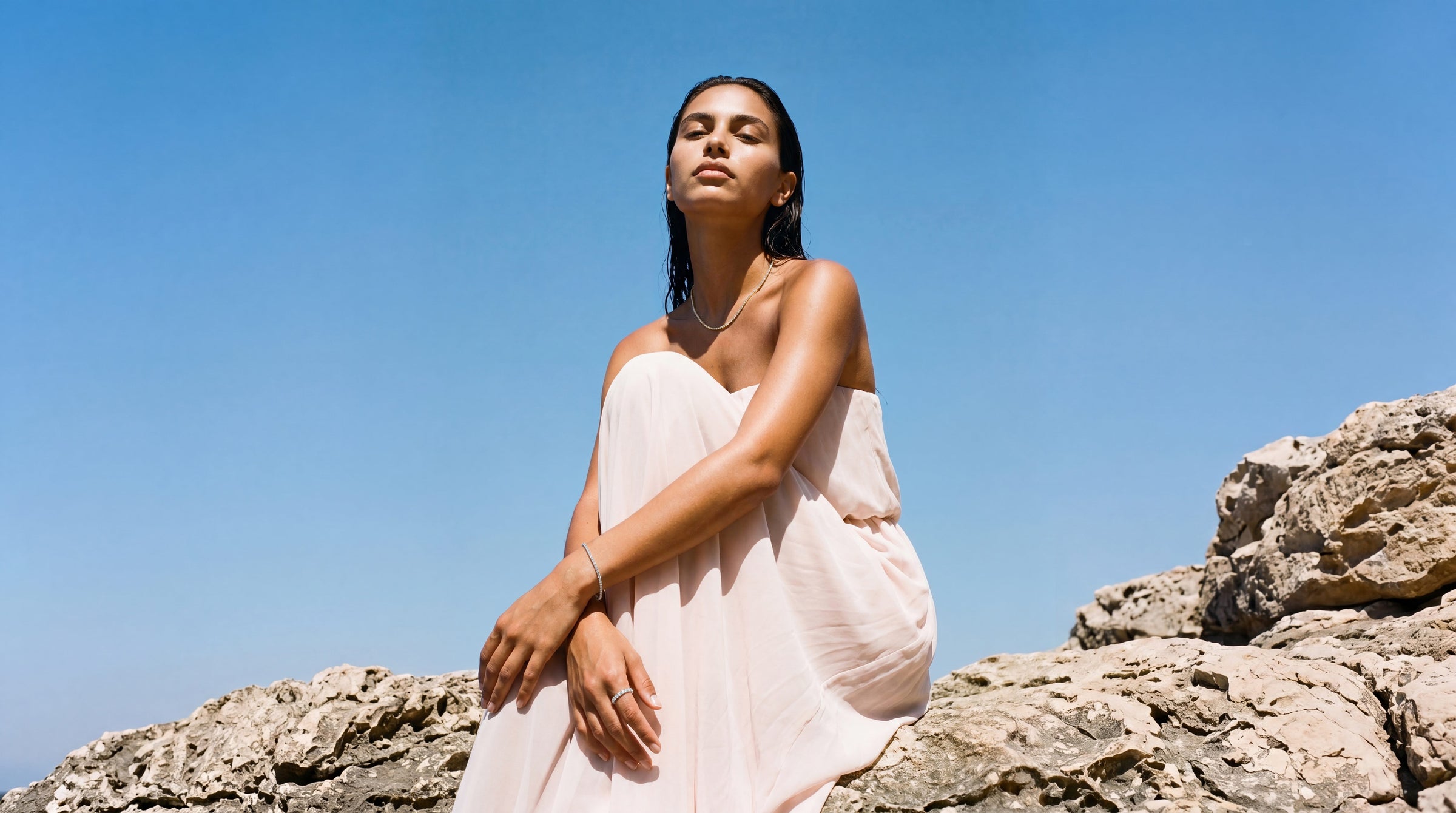
Where It Began.
Bellari was founded in Sydney, Australia by Kay and Dino, inspired by a single tennis bracelet that became a symbol of timeless style.