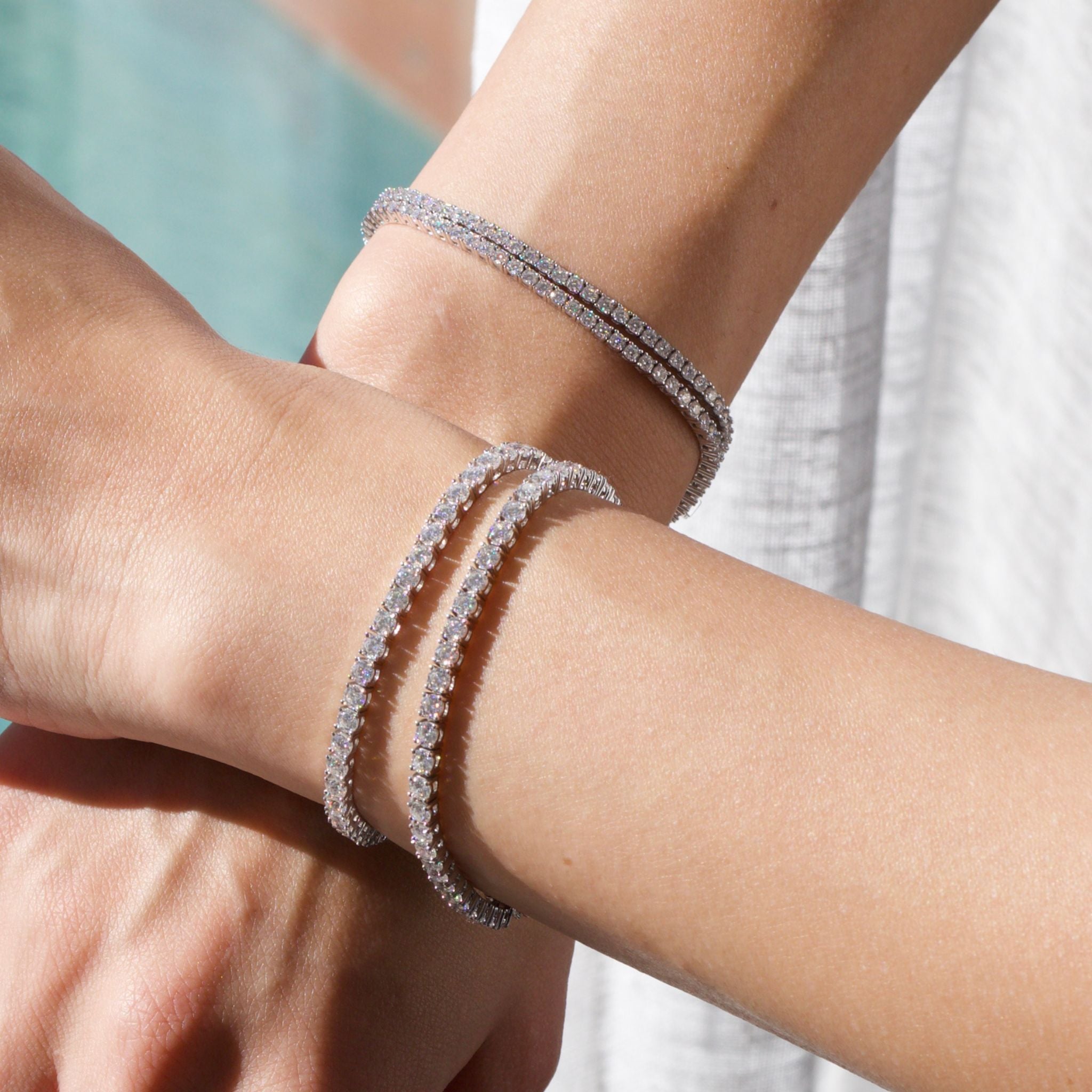
Our Jewellery:
What is moissanite?
Moissanite is a lab-created gemstone made from silicon carbide, a distinct material with its own optical properties, not an imitation of diamond.
It rates 9.25 on the Mohs hardness scale (diamond rates 10), making it appropriate for daily wear across all jewellery types. Its refractive index of 2.65–2.69 exceeds that of diamond (2.42), creating more rainbow fire and brilliance in the same light conditions.
Bellari uses D-colour, VVS1 clarity moissanite across the moissanite collection, the top colour grade (completely colourless) and near-flawless clarity. Every moissanite stone is backed by the Bellari Lifetime Warranty.
Moissanite does not fade, cloud, or lose brilliance over time. It is permanent.
What metals does Bellari use?
What metals does Bellari use?
Moissanite collection: 925 sterling silver with rhodium plating. Rhodium plating creates a bright white finish and protects against tarnish. The eternity band is also available in 10K solid gold.
Lab-grown diamond collection: 18K solid gold, available in yellow gold and white gold. 18K gold contains 75% pure gold. It does not tarnish and requires no plating (yellow gold) or only periodic rhodium re-plating (white gold).
All Bellari pieces are hypoallergenic.
What is a lab-grown diamond?
What is a lab-grown diamond?
A lab-grown diamond is a real diamond, chemically, physically, and optically identical to a mined diamond.
It is grown in a controlled laboratory environment that replicates the natural conditions under which diamonds form underground. The result is pure carbon in crystalline form, the same composition, the same 10 Mohs hardness, the same refractive index, and the same optical properties as an earth-mined stone.
Lab-grown diamonds are graded by the same independent gemological institutes as mined diamonds. Bellari uses only IGI-certified stones — each necklace includes the IGI certificate with the piece.
The difference between a lab-grown and a mined diamond is origin — not quality, appearance, or durability.
Is moissanite a real gemstone?
Yes. Moissanite is a real gemstone with its own distinct chemical composition (silicon carbide) and physical properties.
What makes it real:
Moissanite has a defined crystal structure, hardness rating (9.25 on the Mohs scale), and refractive properties that differentiate it from all other gemstones including diamonds.
It's not a diamond simulant or imitation, it's its own gemstone with characteristics that, in some ways, exceed diamonds (higher refractive index, more fire).
On lab-grown vs natural:
Lab-grown moissanite is chemically and physically identical to the naturally occurring mineral discovered in meteorites. The only difference is origin one is created in a controlled laboratory, the other formed in space.
The same is true for lab-grown diamonds, lab-grown sapphires, and other lab-created gemstones. The process of creation doesn't make them less "real."
Used in fine jewellery:
Moissanite is set in the same precious metals (gold, platinum, sterling silver) and crafted with the same techniques as diamonds and other fine gemstones.
At Bellari, we treat moissanite with the same care and precision as any gemstone.
What jewellery does Bellari offer?
What jewellery does Bellari offer?
Bellari is a Sydney-based jewellery label offering two distinct collections.
Moissanite collection set in rhodium-plated 925 sterling silver:
- Tennis Bracelet Moissanite
- Petal Pink Tennis Bracelet Moissanite
- Tennis Necklace Moissanite
- Tennis Necklace and Bracelet Set
- Stud earrings in round, oval, pear, emerald and radiant cuts
- Eternity Band Moissanite also available in 10K solid gold
Lab-grown diamond collection set in 18K solid gold:
- Round Diamond Necklace
- Oval Diamond Necklace
- Pear Diamond Necklace
- Emerald Diamond Necklace
- All diamond necklaces available in yellow gold and white gold
Every piece arrives in Bellari's signature velvet box with ribbon.
Where does moissanite come from?
Where does moissanite come from?
Natural moissanite comes from meteorites and certain types of rock formations, but these deposits are microscopic and extraordinarily rare.
The discovery:
In 1893, Dr. Henri Moissan discovered tiny silicon carbide crystals in a meteor crater in Canyon Diablo, Arizona. He initially thought they were diamonds due to their exceptional brilliance.
It took years to confirm these crystals were a new mineral later named moissanite in his honour.
Why it's lab-grown today:
Natural moissanite exists in quantities too small for jewellery. The largest natural moissanite crystal ever found measured less than 4mm not even large enough for a single earring stud.
Lab-grown moissanite replicates the same silicon carbide crystal structure through a thermal growing process that takes months under controlled conditions.
On ethical sourcing:
Because moissanite is created in laboratories, there's no mining, no environmental disruption, and complete transparency in origin. Every stone is traceable and ethically produced.
Read our guide on Is Moissanite Real? Everything You Need to Know
What is the difference between moissanite and lab-grown diamond?
What is the difference between moissanite and lab-grown diamond?
They are different gemstones with different properties and different aesthetics.
Moissanite:
- Material: lab-created silicon carbide
- Hardness: 9.25 Mohs
- Refractive index: 2.65–2.69 (higher than diamond)
- Sparkle character: intense rainbow fire, colourful, dynamic
- Setting: rhodium-plated 925 sterling silver (Bellari)
- Available in: tennis bracelets, tennis necklaces, stud earrings, eternity bands
Lab-grown diamond:
- Material: pure carbon (identical to mined diamond)
- Hardness: 10 Mohs
- Refractive index: 2.42 (same as mined diamond)
- Sparkle character: classic white brilliance — clean, traditional
- Setting: 18K solid gold (Bellari)
- Available in: solitaire necklaces (round, oval, pear, emerald cut)
Both are lab-created. Both are real gemstones with permanent optical properties. The choice between them is aesthetic — rainbow fire (moissanite) or classic white brilliance (diamond) — and silhouette.
Explore the moissanite collection or the lab-grown diamond necklaces.